
Ultimate Guide to 3D Welding Tables (System 16 vs 28, Accessories, Setup)
Updated: Apr 22
What is a 3D Welding Table?
A 3D welding table is a modular steel fixturing system designed to hold, position, and align metal parts during welding and fabrication.
It features a grid of precision-machined holes, allowing users to install clamps, stops, and fixtures in any position for maximum flexibility and accuracy.
👉 This system replaces traditional fixed jigs and significantly improves efficiency in modern fabrication.
A 3D welding table is not just a standalone product—it’s part of a complete modular fabrication system. If you're looking for a deeper understanding of how these systems improve workflow, you can explore our ultimate guide to 3D welding tables for a full breakdown of structure, benefits, and real-world applications.

Key Features of a 3D Welding Table
Standard hole systems (System 16 / System 28)
High flatness (0.1–0.3 mm per 1000 mm)
High load capacity (up to 2000 kg/m²)
Modular and reconfigurable design
Compatible with a wide range of accessories
Understanding the grid system is essential when selecting a welding table. The hole pattern directly affects positioning flexibility and clamping efficiency. To learn more, read our guide on choosing the right grid pattern for a welding table and how it impacts productivity.
System 16 vs System 28 Welding Tables
Choosing between System 16 and System 28 depends on your application.
Feature | System 16 | System 28 |
Hole Diameter | 16 mm | 28 mm |
Hole Spacing | 50 mm | 100 mm |
Best For | Small precision parts | Heavy-duty fabrication |
Strength | Medium | High |
Industry Usage | Light workshops | Industrial manufacturing |
👉 Recommendation:Most industrial users choose System 28 for its strength and versatility.
Choosing between different systems is one of the most important decisions. If you want a more detailed comparison, check out our full guide on System 16 vs System 28 welding tables to better understand which option fits your application.

D16 vs D28 Welding Table – Key Benefits
D16 (System 16) – Lightweight & Precision Work
Lighter Weight – Tables, clamps, and fixtures are about 50% lighter than D28, making handling and setup easier.
Higher Precision Grid – Smaller hole spacing provides better positioning accuracy for detailed work.
Cost Advantage – Table tops are more affordable, ideal for entry-level or light-duty applications.
Ideal Applications – Thin materials, small parts, precision fabrication, and flexible setups.

D28 (System 28) – Strength & Heavy-Duty Performance
Superior Durability – Built to withstand long-term industrial use.
Stronger Clamping Force – Up to 50% more clamping power, ensuring maximum stability.
Better Heat Dispersion – Thicker plate acts as a heat sink, reducing distortion during welding.
Higher Load Capacity – Supports up to 2 ton/m² (double the D16 system).
More Fixture Options – Wider range of tooling, stronger and more cost-effective accessories.

Quick Recommendation
Choose D16 → for precision, light-duty, cost-effective work
Choose D28 → for heavy-duty, industrial, high-load applications
How to Set Up a 3D Welding Table
Setting up a welding table correctly ensures precision and repeatability.
Step 1: Level the Table
Use adjustable legs or leveling feet to ensure a flat surface.
Step 2: Install Positioning Tools
Place squares, stops, or locating pins to define your workpiece position.
Step 3: Fix the Workpiece
Use clamps or pneumatic fixtures to secure parts firmly.
Step 4: Verify Alignment
Check angles and dimensions before welding.
Step 5: Start Welding
Once secured, proceed with welding while maintaining stability.
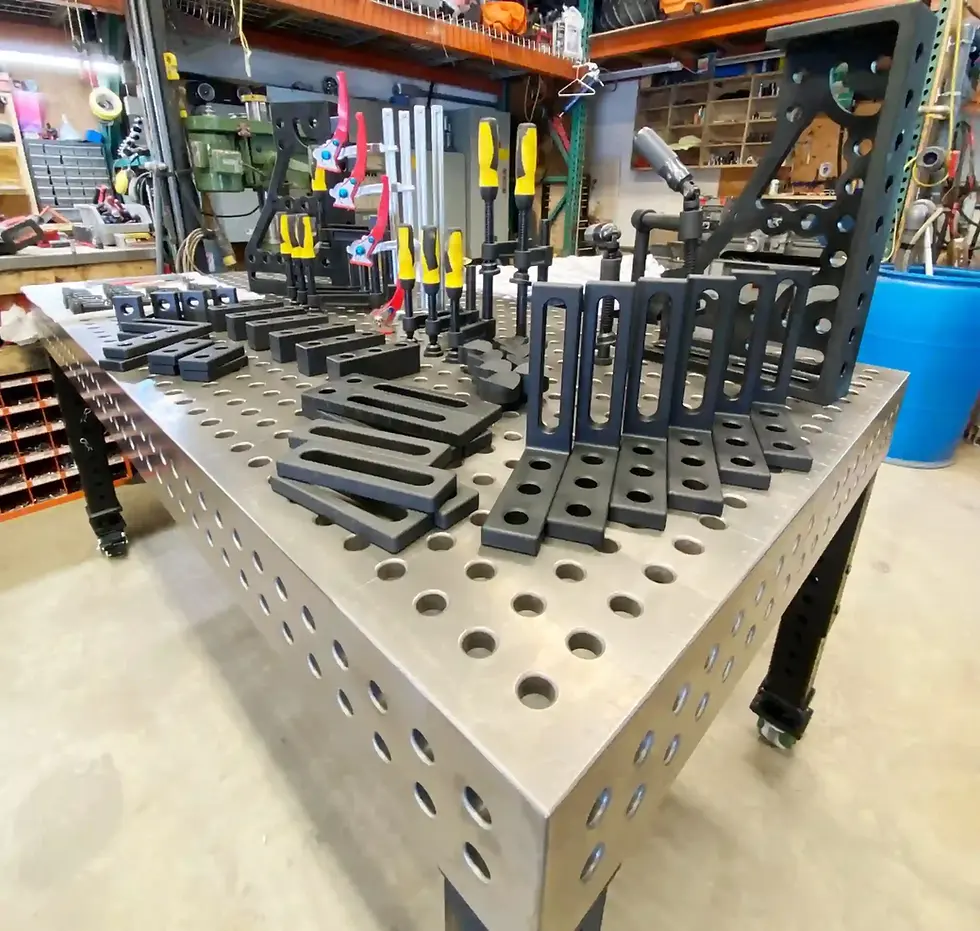
Accessories are essential for maximizing the functionality of your welding table.
Common Accessories:
Clamping bolts
Right angle squares
Stops and locating pins
Riser blocks (U-shape blocks)
Clamping bridges
Support blocks
👉 A complete accessory system allows you to handle complex projects with ease.
Applications of 3D Welding Tables
3D welding tables are widely used across industries:
Steel structure fabrication
Automotive manufacturing
Machinery production
Sheet metal assembly
Custom metal fabrication
👉 They are ideal for both small workshops and large industrial production.

Materials & Surface Treatment
High-quality welding tables are typically made from:
Q355B steel (standard)
Q690 steel (high strength upgrade)
Surface Options:
Standard machined surface
Nitrided surface (recommended)
👉 Nitriding improves:
Wear resistance
Anti-spatter performance
Durability
Precision & Load Capacity
Flatness:
Standard: ~0.1 mm / 1000 mm
Nitrided: ~0.2–0.3 mm / 1000 mm
Load capacity:
👉 up to 2000 kg/m²

FAQ (Frequently Asked Questions)
1. What is a 3D welding table used for?
It is used to fix and align metal parts during welding to ensure precision and repeatability.
2. What is the difference between System 16 and System 28?
System 16 is for smaller, precise work, while System 28 is designed for heavy-duty industrial applications.
3. Is a 3D welding table compatible with Siegmund?
Yes, System 28 welding tables are generally compatible with standard systems like Siegmund.
4. What material is best for a welding table?
Q355B is standard, while Q690 offers higher strength and durability.
5. Is nitriding necessary?
It is not required but highly recommended for longer lifespan and better performance.
6. How accurate is a welding table?
Flatness can reach up to 0.1 mm per 1000 mm for high-quality tables.
7. What accessories do I need?
Basic accessories include clamps, squares, stops, and riser blocks.
8. Can I use pneumatic clamps?
Yes, many users integrate pneumatic systems for faster operation.
9. What size welding table should I choose?
It depends on your workpieces. Common sizes include 1200×800 mm, 2400×1200 mm, and 3000×1500 mm.
10. Does it improve productivity?
Yes, significantly by reducing setup time and improving accuracy.

Why Choose DCT 3D Welding Tables?
DCT welding tables are designed for professional industrial use:
High precision machining
Durable nitrided surface
Full accessory compatibility
Reliable performance in heavy-duty applications
📩 Contact us for quotation
📱 WhatsApp: +86 18028742690
👉 Scan the QR code below to chat with us directly on WhatsApp.


Comments