
China Welding Table Manufacturer: Precision 3D Welding Tables from DCT
Choosing the right welding table affects fixture accuracy, production speed and the repeatability of every welded assembly.
Precision Welding Table is the official website of DCT®, a China-based manufacturer of precision 3D welding tables, modular fixture systems, clamps and positioning accessories.
DCT was founded in 2009 and is based in Shenzhen, China. According to the company’s current profile, its manufacturing facility covers approximately 50,000 square metres and employs more than 300 professionals. The company supplies welding tables and fixtures to customers in the United States, Canada, Australia, New Zealand, Europe and Southern Asia.
Whether you operate a small welding workshop or a large industrial fabrication facility, a modular welding table can provide a more flexible alternative to a conventional steel workbench or a dedicated fixture made for only one product.
What Is a 3D Welding Table?
A 3D welding table is a precision-machined steel work surface with a regular grid of holes for mounting clamps, stops, squares, pins and other fixtures.
Unlike a traditional flat welding bench, a 3D welding table normally has usable surfaces on the tabletop and its vertical sides. This allows fabricators to position and clamp workpieces horizontally, vertically or at an angle.
The modular hole system helps operators create different fixture arrangements without building a completely new jig for every project. DCT welding tables are designed to work with dedicated clamps, quick-locking bolts, positioning stops, angle squares, riser blocks and modular accessories.
A typical setup can be used to:
Hold steel profiles at 90 degrees
Position plates and tubes
Assemble rectangular frames
Support vertical components
Create repeatable batch-production fixtures
Build prototypes and custom welded structures
Prepare workpieces for manual or robotic welding

Why Buy a Welding Table from China?
International buyers searching for a China welding table manufacturer are often looking for a combination of customization, direct factory communication, a broad range of accessories and international shipping support.
DCT manufactures complete modular systems rather than supplying only a bare tabletop. Customers can discuss table dimensions, hole systems, legs, surface treatment and fixture packages according to their workpieces and production process.
The company also offers customized welding tables for small workshops and large industrial production facilities. Its website states that worldwide shipping and customer support are available for international orders.
When comparing suppliers, buyers should evaluate the complete package:
Table size and working height
Hole diameter and grid spacing
Surface flatness
Table thickness and rigidity
Surface treatment
Clamp and accessory compatibility
Packaging and international shipping
Replacement accessory availability
Technical support
Customization capability
The cheapest tabletop may not provide the best long-term value if compatible clamps, stops and replacement fixtures are difficult to obtain.
D16 vs D28 Welding Tables
DCT supplies both D16 System 16 and D28 System 28 welding table solutions.
The correct system depends on the size and weight of the workpiece, the required clamping force and the type of fabrication work.
Feature | D16 System | D28 System |
Hole diameter | 16 mm | 28 mm |
Standard grid | 50 × 50 mm | 100 × 100 mm |
Best suited for | Small and precise components | Medium and heavy fabrication |
Accessory size | Smaller and lighter | Larger and stronger |
Typical users | Light fabrication and compact workshops | Industrial fabrication and large structures |
These dimensions and application recommendations are consistent with DCT’s current System 16 and System 28 product guides.

D16 Welding Table
A D16 welding table uses 16 mm holes arranged on a 50 × 50 mm grid.
The closer hole spacing provides many positioning points, making System 16 suitable for:
Small steel parts
Sheet-metal components
Stainless-steel fabrication
Aluminium products
Furniture frames
Cabinets and enclosures
Prototype work
TIG welding stations
Light and medium fabrication
D16 clamps and fixtures are generally smaller and easier to handle. This system is a practical choice when the workpieces are relatively light and positioning flexibility is more important than maximum clamping strength.
D28 Welding Table
A D28 welding table uses 28 mm holes, usually arranged on a 100 × 100 mm grid.
System 28 is designed for stronger clamping and heavier workpieces. Typical applications include:
Heavy steel frames
Machinery bases
Automotive structures
Industrial equipment
Construction components
Large welded assemblies
Robotic welding fixtures
Medium and heavy fabrication
D28 tables can also be supplied with a diagonal grid arrangement, adding extra positioning points between the standard holes. This configuration can be helpful when fabricators frequently position components at non-standard locations or angles.
Which System Should You Choose?
Choose D16 when your work mainly involves small components, thin materials, detailed fabrication or a compact workshop.
Choose D28 when you manufacture large frames, machinery structures or heavy components requiring stronger clamps and more robust fixtures.
When your projects vary significantly, send DCT your workpiece dimensions, drawings and maximum weight. The team can recommend a suitable system, table size and accessory package.

Why Surface Flatness and Hole Accuracy Matter
A modular welding table is only as accurate as its working surface and hole grid.
If the table surface is uneven, the workpiece may not sit correctly. If the holes have excessive dimensional variation, clamps and locating pins may have unwanted movement. This can affect fixture positioning and the repeatability of finished components.
DCT explains that precision hole tolerances help fixtures fit securely while still allowing clamps and accessories to be inserted and removed efficiently. Its tables are manufactured using precision machining and are available with nitrided surfaces.
Before ordering a China 3D welding table, ask the supplier to confirm:
Surface flatness tolerance
Hole diameter tolerance
Grid-position accuracy
Tabletop thickness
Side-wall dimensions
Material specification
Surface treatment
Inspection procedure
For custom or high-accuracy applications, provide the required tolerance in writing before production.
What Is a Nitrided Welding Table?
A nitrided welding table receives a surface-hardening treatment that diffuses nitrogen into the steel surface.
The treatment is used to improve surface hardness and resistance to wear. A nitrided surface can also make regular maintenance and removal of welding residue easier than on an untreated mild-steel surface.
DCT offers nitrided welding tables and describes the treatment as a way to improve durability and surface performance in fabrication environments.
A nitrided table can be especially useful for workshops where the surface is regularly exposed to:
Welding spatter
Heavy clamps
Steel profiles
Repeated workpiece loading
Fixture changes
Industrial workshop conditions
Surface treatment does not remove the need for proper care. Operators should still keep the tabletop clean, avoid unnecessary grinding on the working surface and follow the supplier’s maintenance recommendations.

Welding Table Clamps and Accessories
A modular table becomes much more useful when it is combined with the correct fixture package.
DCT supplies accessories for positioning, supporting and clamping different workpieces. These include:
Quick-Locking Bolts
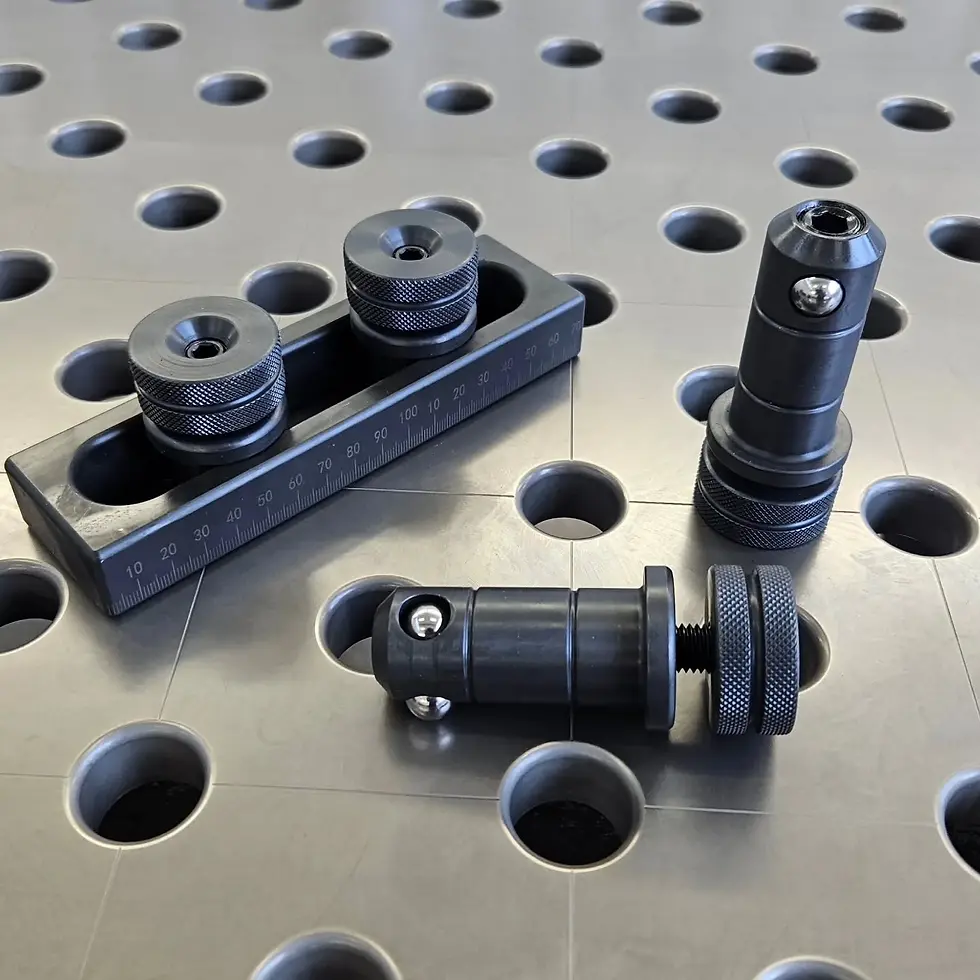
Quick-locking bolts connect angle squares, stops, rails and other fixtures to the welding table.
They allow operators to change a fixture arrangement more quickly than with conventional nuts and bolts.
Screw Clamps
Screw clamps apply adjustable pressure to hold workpieces against the table, a stop or an angle square.
They can be used for profiles, tubes, plates and welded frames.
Toggle Clamps
Toggle clamps are useful for repeated loading and unloading. After the clamp position is set, the operator can open and close it quickly.
They are suitable for batch-production fixtures.
Positioning Stops
Stops provide a fixed reference point for locating a workpiece.
They are particularly useful when several identical parts need to be produced using the same setup.
Angle Squares
Angle squares help position plates, profiles and frames vertically or at 90 degrees.
Small squares suit compact components, while larger three-dimensional squares provide support for tall or heavy workpieces.
Riser Blocks
Riser blocks extend the working surface and create additional vertical or elevated positioning options.
DCT offers D28 riser blocks designed for table extensions, vertical positioning and modular fixture setups.
Positioning Pins and Rails
Pins provide fast alignment, while slotted rails allow finer adjustment before the fixture is tightened.
DCT’s clamp guide confirms that its modular system supports clamps, positioning tools and fixtures designed around the table’s hole grid.

Applications for DCT 3D Welding Tables
DCT welding tables can be used in a broad range of metalworking environments, including:
General metal fabrication
Machinery manufacturing
Automotive component production
Structural steel fabrication
Cabinet and enclosure production
Agricultural machinery
Stainless-steel fabrication
Steel furniture manufacturing
Doors, gates and railings
Construction equipment
Robotic welding
Welding schools
Research and development
Prototype production
Small-batch and repeat production
The same table can be reconfigured for multiple products by moving the clamps, stops and positioning squares.
This flexibility can be especially valuable for job shops that handle changing orders and cannot justify storing a separate dedicated fixture for every component.

How to Select the Correct Welding Table Size
The table should be large enough to support your regular workpieces without occupying unnecessary workshop space.
Before requesting a quotation, prepare the following information:
Maximum workpiece length
Maximum workpiece width
Maximum workpiece height
Maximum workpiece weight
Main material type
Material thickness
Welding process
Required working height
Required hole system
Expected production volume
Preferred table legs or casters
Accessories required
Delivery city and country
A table slightly larger than the normal workpiece may provide enough space for clamps and stops. However, buying a table far larger than necessary can increase the purchase price, weight and shipping cost.
For oversized structures, multiple tables or extension blocks can sometimes be connected to create a larger working area.
Custom China Welding Table Solutions
Not every workshop needs the same table.
Precision Welding Table can discuss custom configurations based on the customer’s production requirements. Available options may include:
Custom length and width
D16 or D28 hole system
Standard or diagonal hole grid
Different side-wall heights
Fixed or adjustable legs
Mobile configurations
Plasma-nitrided surface
Custom fixture packages
Clamp and angle-square combinations
Riser blocks and table extensions
Tool storage solutions
Export packaging
For the most accurate recommendation, send clear photographs or technical drawings of the workpiece.
Include information about where it must be clamped, which surfaces need to remain accessible and whether the setup will be used for manual or robotic welding.
Why Work with DCT Precision Welding Table?
DCT focuses on complete 3D welding table and fixture systems.
The company’s current profile highlights:
Manufacturing experience since 2009
50,000-square-metre facility
More than 300 professionals
D16 and D28 systems
Custom welding table production
Complete clamp and fixture packages
ISO 9001 and ISO 14001 certification
Worldwide shipping
Support for international customers
These details are published on DCT’s official About and Contact pages.
Customers can order a complete welding table system or discuss individual replacement fixtures and accessories.
Frequently Asked Questions
Is DCT a China welding table manufacturer?
Yes. DCT is based in Shenzhen, China, and manufactures 3D welding tables, fixtures, clamps and modular accessories.
What is the difference between D16 and D28 welding tables?
D16 uses 16 mm holes on a 50 × 50 mm grid and is suited to small, precise and relatively light fabrication. D28 uses 28 mm holes on a 100 × 100 mm grid and is intended for stronger clamping and heavier industrial work.
Does DCT offer nitrided welding tables?
Yes. Plasma-nitrided surface options are available for customers requiring improved surface durability and wear resistance.
Can DCT manufacture a custom welding table?
Yes. Customers can discuss customized dimensions and configurations according to their workpiece, workshop and production process.
What accessories are available?
Available accessories include quick-locking bolts, screw clamps, toggle clamps, stops, positioning rails, angle squares, pins, support blocks and riser blocks.
Can a 3D welding table be used with a welding robot?
Yes. Modular tables can be configured as repeatable workholding platforms for robotic welding cells. The fixture arrangement should be designed according to robot reach, torch access and workpiece loading requirements.
Does Precision Welding Table ship internationally?
Yes. DCT states that it supplies customers internationally and offers worldwide shipping support.
What information is needed for a quotation?
Provide the required table dimensions, D16 or D28 system, workpiece size and weight, required accessories, quantity and delivery destination.

Contact Precision Welding Table Today
Are you looking for a reliable China welding table manufacturer, a custom 3D welding table or a complete modular fixture package?
Send us your workpiece drawing, required table dimensions and destination. Our team will help you select a suitable D16 or D28 system.
WhatsApp: +86-180-2874-2690
Contact Precision Welding Table today for product information, technical specifications, accessory catalogues, quotations and distributor cooperation.


Comments